How to Fund an AI Project as an SME in France
By Alexandre Saint-Jean
Audio version
Audio version produced by text-to-speech from the article. Our AI charter
If your business operates in France, an AI project is almost never something you have to fund on your own, and that is good news. Several public schemes sharply cut the cost, provided you know which one to use for which purpose. The key is not to look for a single grant that covers everything, but to combine three levers, each targeting a specific stage: the assessment, training, implementation. Here is how they fit together, and the pitfalls to avoid.
Why think in terms of stages rather than a single grant?
Most business owners search for "the" AI grant. It does not exist, and looking for it wastes time. An AI project breaks down into three stages, and each has its own funder:
- The assessment: identifying where AI creates value in your business, and at what return. Funded by Bpifrance.
- Training: bringing your teams up to speed to use AI and meet your obligations. Funded by your OPCO.
- Implementation: rolling out the chosen use cases. Supported by your region and the France Num network.
Once you have that split clear in your mind, the schemes become easy to read and stack naturally.
The assessment: Bpifrance's Diag Data IA
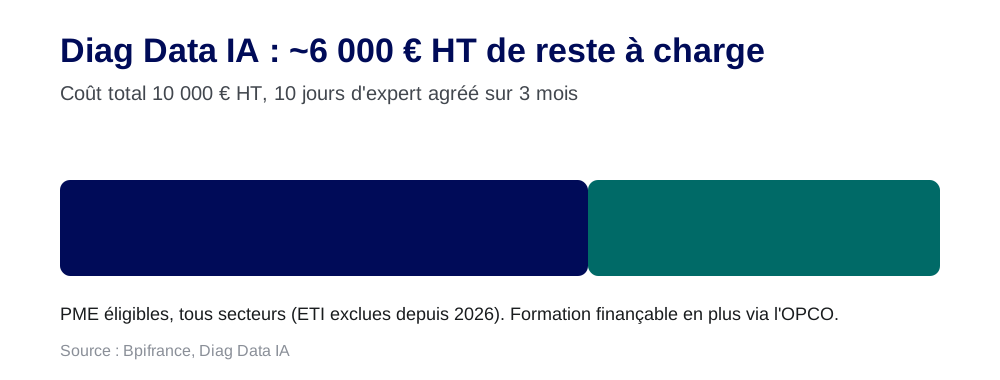
Diag Data IA co-funds a diagnostic carried out by an accredited expert, over roughly 10 days spread across about 3 months. It is the ideal entry point: it maps your data and processes, identifies priority use cases and their return, and most often results in 2 to 3 concrete workstreams rather than a report that sits in a drawer.
Is my business eligible?
The scheme targets SMEs and mid-sized companies with 10 to 2,000 employees, generating at least €1 million in turnover over a 12-month period, trading for more than a year, in any sector. In practice, the vast majority of industrial, service or trading SMEs qualify. The real point to watch is not the sector, it is how mature the topic is internally: you need a baseline of data and genuine willingness from leadership to act on the findings.
What does it actually cost?
This is the heart of the matter. Bpifrance's co-funding brings the amount the business has to pay well below the price of a standard assessment. As a rough figure, expect around €6,000 excl. VAT left to pay after a 40% contribution (the rate in force since June 2026, having previously stood at 42% and then 25% earlier in the year). Compare that with the real cost of an AI diagnostic run over 10 days by an independent expert. Note that mid-sized companies are eligible on the same basis as SMEs, up to 2,000 employees.
The role of the accredited expert (and why it matters to you)
The Diag is carried out by a Bpifrance-accredited expert, named individually (intuitu personae) on the platform. In practice, Bpifrance does not impose a provider on you: you name the expert of your choice, provided they are accredited. That leaves you in control of who carries out the work, which makes a real difference to the quality and business relevance of the diagnostic.
Training your teams: your OPCO
Training your staff in AI can be funded through your OPCO, covering a large share, sometimes all, of the cost depending on your headcount and sector. It is the fastest lever to activate, and often the most cost-effective, since bringing your teams up to speed delivers immediate gains with no heavy technical investment.
Why Qualiopi accreditation makes this simple
OPCO funding requires the training to be delivered by a provider certified Qualiopi (France's official training-quality accreditation). The good news: it is the provider that holds the certification, not you. Going through a Qualiopi partner means you get the funding with no certification process of your own to handle. A non-certified trainer can even deliver the course as a subcontractor to a Qualiopi provider, which widens your choice of experts.
The link to your AI literacy obligation
AI training is not just a nice-to-have: since February 2025, the EU AI Act has required a baseline level of AI literacy for anyone using these tools. Funding your teams' training through your OPCO kills two birds with one stone: you build capability, and you meet a regulatory obligation already in force (we cover the full framework in our article on what SMEs need to do under the EU AI Act).
Implementation: regional grants and France Num
Once the assessment is done and teams are trained, rolling out the use cases can also be supported. Depending on your sector and region, digital transformation schemes fund part of the implementation. The France Num network lists the support available, and the Activateur France Num status helps identify accredited support providers. In Nouvelle-Aquitaine in particular, regional digitalisation vouchers can cover a significant share of the project.
Outdated schemes not to confuse with the current ones
This is where a lot of articles get it wrong and waste your time. Several often-cited schemes are no longer usable, or never actually funded AI adoption:
- The €500 France Num voucher: closed since 2021. It should no longer feature in any funding plan.
- The business owner training tax credit: repealed by the 2026 finance law.
- The Innovation Tax Credit (CII): its rate is 20%, not 30%, and it funds product innovation, not the adoption of AI tools internally. Like CIR (France's Research Tax Credit), it is not an adoption scheme.
- "Labelled France Num": this is a directory listing (Activateur status), not an official quality label. Useful, but should be presented for what it is.
Working from the schemes actually in force avoids false promises and makes your application more credible.
How do you combine the three across a project?
The schemes do not overlap, they follow on from each other. Here is the typical path for an SME funding its AI project end to end:
| Stage | Covers | Scheme | Funder |
|---|---|---|---|
| 1 | Assessment and scoping | Diag Data IA | Bpifrance |
| 2 | Upskilling | Training plan | OPCO |
| 3 | Rollout | Digital transformation grant | Region / France Num |
The right move is to check eligibility and file the applications as soon as you scope the project, not afterwards. A funded assessment leading to funded training, then supported implementation: that is an AI project whose cost to the business is a fraction of buying the work outright.
Where to start
Start with the assessment: it shapes everything that follows. Once the priority use cases are identified and costed, the training plan and the implementation follow naturally, and each finds its own funder. This is precisely the support I provide, from putting the applications together through to delivering the workstreams, keeping quality under control at every stage.
Frequently asked questions
- Who can access Bpifrance's Diag Data IA scheme?
- SMEs meeting minimum headcount and turnover thresholds, trading for more than a year, in any sector. The scheme co-funds a diagnostic carried out by an accredited expert, which sharply reduces the amount the business has to cover itself.
- Can employee AI training be funded, if your business operates in France?
- Yes, through your OPCO, covering a large share or the full cost depending on your headcount. Going through a provider certified Qualiopi (France's official training-quality accreditation) means you get the funding without having to handle any certification process yourself.
- Can you combine several funding schemes?
- Yes, they cover different things: Diag Data IA for the assessment, OPCO for training, regional grants for implementation. They combine across a project timeline, without overlapping.
- How long does it take to put a funding application together?
- Launching a Diag Data IA is fast once you have identified the expert, since it is the business that names them on the Bpifrance platform. For OPCO funding, the request has to be filed before training starts. The right approach is to start the paperwork when you scope the project, not once it is already under way.
- Does the business owner training tax credit still exist in 2026?
- No. That tax credit was repealed by the 2026 finance law. It is a typical example of a scheme still mentioned everywhere that is no longer usable. Plan around the schemes actually in force: Bpifrance's Diag, your OPCO, and regional grants.