Agentic AI in Finance: Agents for Accounting and Cash Flow
By Alexandre Saint-Jean

Audio version
Audio version produced by text-to-speech from the article. Our AI charter
Finance is ideal ground for AI agents: plenty of repetitive tasks, explicit rules, high volumes. It is also a domain where mistakes are costly, which makes it a good case study for understanding where an agent genuinely helps, and where a human must keep control.
Why finance suits agentic AI so well
A large share of financial work consists of cross-checking sources, organising information and preparing decisions, exactly the kind of task agentic AI handles well. But finance also demands a stronger standard of reliability and traceability than most other functions. The best agent in finance is therefore not the most autonomous one, it is the most tightly bounded one. This point builds directly on our definition of an AI agent.
Where an agent genuinely helps
The strongest use cases sit in preparation and control, not in the final decision.
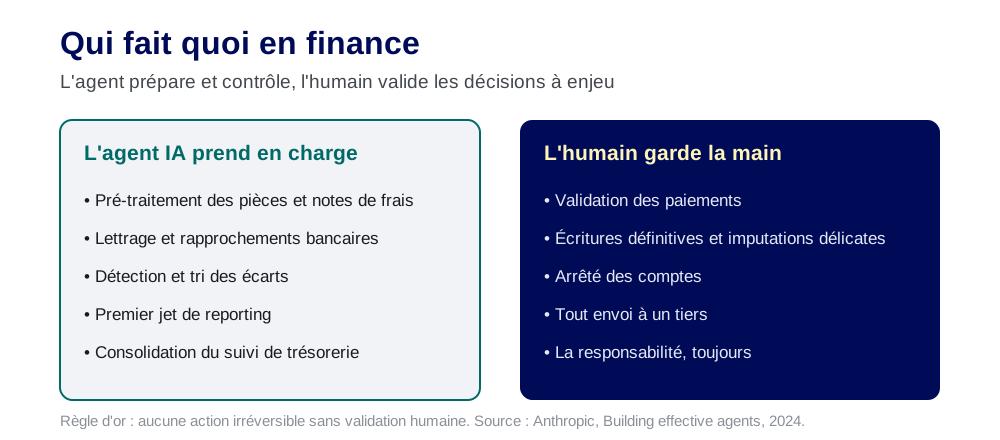
- Document pre-processing: reading invoices and expense claims, extracting the data, drafting a first classification for review.
- Matching and reconciliation: matching entries, payments and bank statements, and flagging discrepancies for review.
- Reporting: pulling together scattered figures and producing a first draft of a regular summary.
- Cash flow tracking: consolidating due dates, flagging upcoming pressure points, drafting customer follow-ups.
In each of these cases, the agent makes the first pass and the finance professional decides. The same logic runs through our broader guide to AI agent use cases by department, with a stronger requirement for control here.
Where a human must stay in control
The line is clear and non-negotiable. No payment, no final entry, and nothing sent to a third party is triggered without human validation. The agent prepares the decision, it does not make it. This rule protects against both model error and accountability, which remain entirely human.
It also marks the difference between an agent and simple automation: for a standard, stable reconciliation, classic automation is enough, as explained in our comparison between AI agents, chatbots and automation. An agent only earns its place where the case calls for judgement at every step.
A concrete example
Take supplier invoice reconciliation. The agent pulls in incoming invoices, retrieves the matching purchase order and goods receipt, checks price and quantity, and sorts each line into three piles: matching, minor discrepancy, or needing a decision. The finance team only handles the last two piles, already documented. Processing time drops, and, more importantly, discrepancies stop slipping through unnoticed. The agent has not decided anything irreversible: it has prepared clean, reviewable work.
How to get started in finance
Connecting an agent to your accounting software and your data is an integration project in its own right: access rights, security, supervision. That is exactly what our guide to AI and ERP integration covers, and it matters even more given how much care financial data deserves.
Before integrating anything, scope the work. A diagnostic identifies the finance use case with the best return relative to risk for your business, and, for a company operating in France, can fall under a publicly funded diagnostic for the finance function. In finance more than anywhere else, progress comes in small, verified steps, never in one big leap.
Frequently asked questions
- Can an AI agent do my bookkeeping for me?
- No, and that is not the point. An agent prepares, categorises and checks, but closing the books, difficult classification decisions and accountability remain human. The agent saves time on repetitive work, not on accounting judgement or legal responsibility.
- Is agentic AI reliable enough for financial numbers?
- Only if it is properly bounded. An agent built on a language model can make mistakes, so it is never given the final word on an amount. It prepares a reconciliation or a first pass, which a human then validates. Reliability comes from the control layer, not from blind trust.
- Do I need to change accounting software to use an agent?
- Not necessarily. An agent connects to your existing tools through connectors. The point is not to replace everything, but to integrate the agent properly into your system, with the right access rights and the right level of supervision.
Sources
Go further
What is an AI agent? The full definition