What Is an AI Agent? Definition, How It Works, Examples
By Alexandre Saint-Jean

Audio version
Audio version produced by text-to-speech from the article. Our AI charter
The word "agent" has taken hold in a matter of months, often without a clear definition. Yet the idea itself is simple, and it changes a lot for a business. Here is what an AI agent actually is, how it works, and where the boundary sits with the tools you already know.
What is an AI agent, in practice?
An AI agent is software that pursues a goal across several steps, deciding for itself which actions to take. You do not give it a single command, you give it an objective: "match these invoices against purchase orders and flag the discrepancies." It breaks the work down, uses the tools it needs, and stops once the goal is reached.
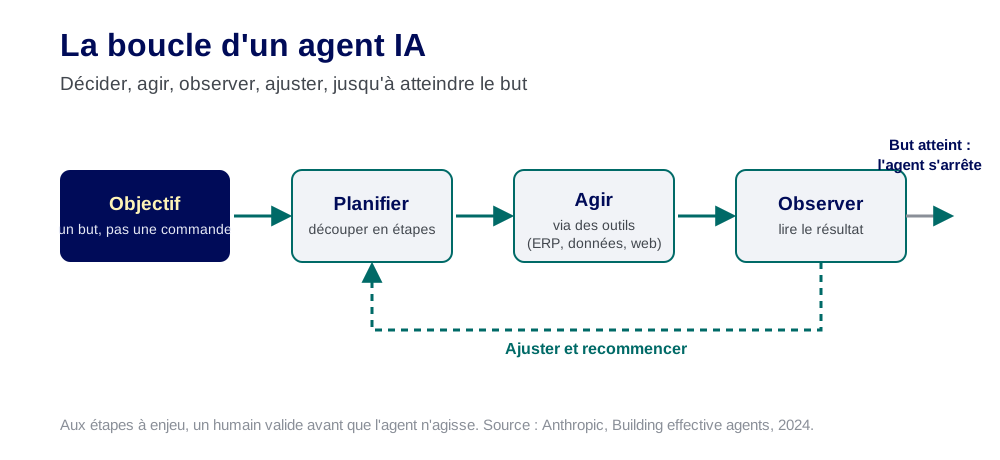
The difference from a classic assistant comes down to one word: action. An assistant answers a question and stops there. An agent acts on your systems, observes what happens, and adjusts its approach. That loop between decision and action is what defines what people now call agentic AI.
This distinction is not just a matter of vocabulary. It matters enough to deserve its own article: we cover it in detail in our comparison between AI agents, chatbots and automation, which untangles three notions that get confused constantly.
How does an AI agent work?
An agent relies on a reasoning engine, usually a large language model, wrapped in three capabilities. Understanding these pieces helps you see where an agent is useful, and where it hits its limits.
Planning
Starting from the goal, the agent breaks the work into steps. Rather than executing everything as one block, it reasons about the order of actions and what information it is missing. This planning can be simple, a list of steps, or more elaborate depending on the complexity of the task.
Using tools
This is the heart of the matter for a business. An agent is only as useful as what it can reach: your ERP, your inbox, a database, a search engine. You give it access to these through connectors. An open standard, the Model Context Protocol, has become a common way to connect an agent to software and data sources, which cuts the cost of integration.
Memory and observation
After each action, the agent reads the result and factors it into what comes next. If an invoice does not match any purchase order, it does not carry on regardless: it notes the discrepancy and adapts. This loop of observation and adjustment is what separates an agent from a macro that runs a fixed script.
As Anthropic's work on building effective agents summarises, published in late 2024, sophistication is not an end in itself: the most reliable systems are often the simplest ones, with just enough autonomy for the actual need.
How is an agent different from a chatbot?
A chatbot replies, an agent acts. A chatbot holds a conversation and produces text, which is valuable for information or first-line support. An agent, by contrast, triggers real operations: creating a customer record, running an export, chasing a supplier.
Many tools marketed as "agents" are really just chatbots with extra polish. The test is simple: if the tool only talks, it is not an agent. If it acts on your systems to reach a goal, it is one. This distinction saves you from buying a promise the tool cannot actually keep.
What is an AI agent used for in business?
The most profitable use cases are rarely the most spectacular. They are repetitive tasks with clear rules, where the agent saves time without replacing human judgement. The same families of use cases turn up across sectors.
- Document processing: reading invoices, delivery notes or contracts, extracting the data and filing it in the right place.
- Reconciliation and controls: cross-checking two sources, spotting discrepancies, preparing a decision without making it.
- Customer service: qualifying an inbound request, retrieving context, drafting a reply for a human to approve.
- Reporting: pulling scattered figures together into a regular summary.
We cover these situations department by department in our guide to AI agent use cases by department. For a detailed example in a demanding domain, agentic AI in finance shows what an agent changes in accounting and cash management, with the safeguards that are essential there.
Do you need to know how to code to build an AI agent?
Not always. For simple tasks, no-code and low-code platforms such as n8n, Make or Copilot Studio let you assemble an agent from building blocks, without heavy development. That is often the right starting point to test an idea at low cost.
More demanding needs change the picture. Once an agent needs to connect to an ERP, handle sensitive data or carry a real load, integration becomes a genuine engineering question: security, access rights, supervision. That is where connecting AI to your business tools becomes essential, with particular attention to data control.
How do you get started without making mistakes?
The worst approach is trying to "put AI everywhere". The right one is choosing a first use case that is genuinely annoying, well defined, measurable and low risk. An agent that saves two hours a week on a tedious task, without touching a critical decision, beats an ambitious project that never leaves the lab.
This shift goes beyond the internal use of agents: how your customers find your business is changing too, as search engines increasingly answer directly with AI-generated summaries. See what the arrival of AI Overviews means for a small business's visibility.
This is exactly what a structured diagnostic sets out to do: identify where an agent creates value for you, price the gain against the effort, and sequence the rollout. For a business operating in France, this diagnostic can fall under a publicly funded AI assessment. Start small, measure, extend what works. On how to deploy, the forward deployed engineer model explains why working directly with your real data changes the outcome.
Frequently asked questions
- Is an AI agent just a better ChatGPT?
- No. A language model, like the one behind ChatGPT, generates text. An AI agent uses that model as a decision engine, but adds the ability to act: calling tools, reading and writing to your systems, chaining steps towards a goal. The model is the brain, the agent is the brain plus the hands.
- What is the difference between agentic AI and classic automation?
- Classic automation follows a fixed path, programmed in advance. Agentic AI decides its path at execution time, based on what it observes. Automation is rigid and predictable, an agent is flexible but needs guardrails. The two are often combined.
- Can an AI agent get things wrong?
- Yes, like any system built on a language model. That is why you define its scope, keep a human in the loop for decisions with real stakes, and log its actions. An agent is not an infallible colleague, it is a fast worker that needs supervision.
- How much does it cost to set up an AI agent in a small business?
- It depends on the use case. A no-code agent on a simple task can be built in a few days. An agent connected to an ERP, handling sensitive data, needs a bespoke integration. A funded AI diagnostic helps price the right first step before you invest.
Sources
Go further
Understanding AI agents