AI in Supply Chain: Connecting AI to Your OMS and WMS
By Alexandre Saint-Jean
Audio version
Audio version produced by text-to-speech from the article. Our AI charter
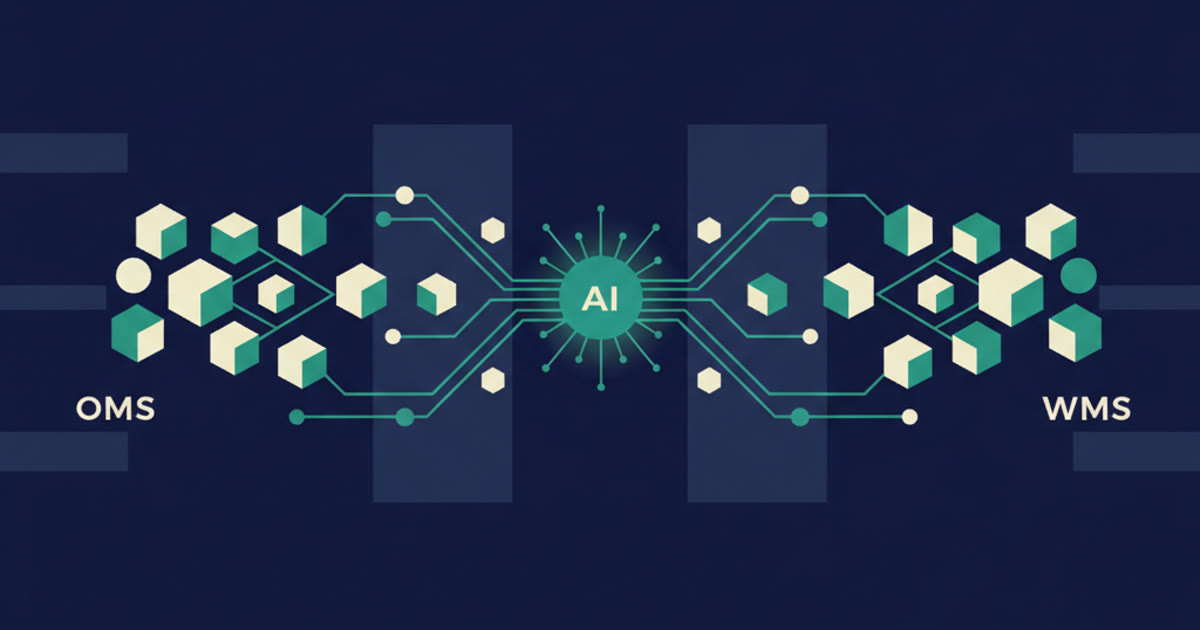
An OMS orchestrates orders, a WMS runs the warehouse, and together they generate a volume of data every day that few companies actually put to use. Connecting AI to that data does not mean automating everything: it means reading these flows, forecasting, qualifying issues and freeing up time on repetitive tasks, with a human keeping the decision. This article is part of our overview of AI by industry.
What data do an OMS and a WMS actually generate?
An OMS (Order Management System) centralises orders from every sales channel: online store, marketplaces, physical stores, B2B. It knows at every moment where each order stands, what stock is committed, and which carrier is due to deliver.
A WMS (Warehouse Management System) runs the warehouse: receiving, put-away, picking, shipping. It logs every stock movement, every gap between what was expected and what arrived, every picking anomaly.
Put together, these two systems build a detailed history of orders, stock, lead times and incidents. That is a raw material rarely used beyond a fixed monthly report, even though it carries signals worth acting on daily.
How does AI help forecast stock levels?
The first useful ground is stock projection. Based on sales history, seasonality and supplier lead times recorded in the OMS and WMS, AI can estimate future needs SKU by SKU, and flag stockout or overstock risk before it happens.
The principle stays simple: AI proposes a quantity and an order date, the buyer adjusts and approves. This is not autopilot for purchasing, it is an early, evidence-based warning about something that, without it, would only surface too late, at the point of stockout or an overflowing warehouse.
The gain shows up on two fronts: fewer lost sales from unavailable stock, and less cash tied up in slow-moving SKUs. Both problems are costly, and both are visible in the same sales and stock-movement data.
How does AI help resolve logistics disputes?
A carrier dispute, a receiving discrepancy or a lost parcel almost always follows the same pattern: gather the evidence (delivery note, photo, tracking history), qualify the issue, build a claim, then chase if the response is slow. It is precise but repetitive work, taking up time without requiring complex judgement at every step.
AI connected to OMS and WMS data can assemble that case automatically: it finds the relevant order, cross-checks delivery statuses, identifies the gap, and drafts the claim text ready to send. Follow-ups, often dropped for lack of time, become systematic.
The same principle applies to reference data quality. Duplicate barcodes, incomplete product records, inconsistent units of measure between systems: AI can flag these anomalies by comparing reference data across systems, before they cause a picking error or a checkout failure.
How do you query your logistics flows in plain language?
Beyond static dashboards, AI connected to the OMS and WMS turns into a kind of queryable control tower: ask a plain-language question, such as "which orders are late and why," and get an answer built from real data, not a preformatted report.
This kind of use case changes how day-to-day operations get tracked. A logistics manager no longer needs to pull a file and cross-reference it by hand to understand a recurring delay at a warehouse or with a carrier: the question gets asked directly, and the answer cites the orders involved.
How do you connect technically to an OMS and a WMS?
Most modern OMS and WMS platforms expose an API: that is the natural entry point to read orders, stock and movements without touching the underlying system. It is also the most stable path, independent of the software's internal interface changes.
Two complementary approaches build on that API. The Model Context Protocol is an open standard for linking AI to business software in a standardised way, rather than coding a custom connector for each tool. It simplifies integration when several systems need to be connected together.
The other approach, more accessible to get started, goes through an orchestration platform like n8n, which links several pieces of software together without heavy development. We cover this in practice in orchestrating these flows with n8n. France Num documents this kind of progressive tooling approach for SMEs without a dedicated technical team, in a French context.
In every case, the recommended sequence is the same: start with read-only access to the data (no actions, just analysis), then introduce low-risk, reversible actions (drafting a case, an alert, a draft order), and only hand over a high-stakes action once several weeks of observed reliability back it up.
What guardrails should you put in place before you start?
The first guardrail concerns purchasing. AI should never place a supplier order without human approval: the cost of a volume or reference error far outweighs the time saved by full automation. AI proposes, the buyer decides, always.
The second guardrail concerns traceability. Every action initiated by AI on order or stock systems needs to be logged and attributable, exactly like a human action. That is what lets you revisit a decision, audit a mistake, and keep the trust of the teams using the tool day to day.
The third guardrail concerns scope. A narrow, reliable use case (carrier disputes, for example) beats a project that touches stock, purchasing and transport all at once in month one. Bpifrance Big Media regularly documents this logic of progressive, sector-by-sector deployment rather than one big project.
How do these flows extend beyond logistics?
Order flows do not stop at the warehouse door. On the sales side, the online store version of these flows shows how to connect AI to an e-commerce site's data, upstream of the OMS. On the finance side, once order and delivery flows are reliable, it becomes natural to extend into invoicing and accounting, closing the loop through to payment.
Where should you actually start?
The safest starting point remains a narrow use case: carrier disputes or receiving discrepancies, on a limited, measurable scope. That is where the gain shows up fastest, and where trust in the tool builds before extending to stock and then purchasing.
If your company operates in France, Bpifrance's Diag Data IA scheme funds this diagnostic at 40%, leaving roughly €6,000 excl. VAT to pay (open to SMEs and mid-sized companies with 10 to 2,000 employees). It maps your existing OMS and WMS flows, puts a number on the first use case, and avoids investing in an integration that ends up pointed at the wrong data.
Past that diagnostic, the next step is the integration itself: connecting AI to your existing systems, with the access rights and oversight that fit your organisation. That is exactly what our support for integrating AI into your IT systems covers.
Frequently asked questions
- Can AI place supplier orders on its own?
- That is not recommended. AI can calculate a demand projection and propose an order, but sign-off should stay with the buyer. Automating purchasing without supervision exposes you to volume or price errors that cost more than the time saved. A human keeps the final call.
- Do you need to change your OMS or WMS to use AI?
- No, in the vast majority of cases. AI connects to the data these systems already produce, through their APIs or an intermediate connector. The goal is not to replace the business tool, it is to use the flows it already generates.
- What is the first use case to test in logistics?
- Carrier or receiving disputes: it is repetitive, time-consuming, and narrow in scope (one parcel, one discrepancy, one claim). AI gathers the evidence and drafts the case, a human approves before it goes out. The gain is measurable within the first week.
- How do you fund a first AI project on logistics flows if you operate in France?
- For an SME operating in France, Bpifrance's Diag Data IA scheme co-funds a diagnostic at 40%, leaving roughly €6,000 excl. VAT to pay. It is open to SMEs and mid-sized companies with 10 to 2,000 employees, and it helps put a number on the first use case before investing in the integration.
Sources
Go further
AI by industry