How France Funds AI Projects for SMEs: 2026 Guide
By Alexandre Saint-Jean
Audio version
Audio version produced by text-to-speech from the article. Our AI charter
If your company operates in France, several public schemes let you fund an AI project in 2026 without carrying the full cost alone. This guide is written specifically for that situation: it will not help a company with no presence in France, because none of the schemes below apply outside the country. The trick is not chasing "the" AI grant, because it does not exist. It is combining three levers across three distinct stages: the assessment, the training, and the rollout. The national "Osez l'IA" plan, launched in July 2025 and reinforced in June 2026, sets the overall framework. Bpifrance's Diag Data IA covers 40% of the assessment cost, leaving roughly €6,000 excl. VAT to pay. The relevant OPCO funds the team's upskilling. Regional grants support the rollout. This guide lists the schemes actually worth applying to, and flags the ones that are dead or do not apply to AI adoption.
Which schemes actually fund AI adoption in France in 2026?
Three active levers form the backbone of AI funding for a French SME, covering three distinct stages.
The assessment and scoping stage. The entry point is Bpifrance's Diag Data IA, part of the national "Osez l'IA" plan. It co-funds a diagnostic carried out by an approved expert over roughly 10 days, spread across three months.
Staff training. Your sector's OPCO can cover a large share, sometimes all, of the cost of AI training, provided you go through a Qualiopi-certified provider.
The rollout. Regional digital transformation grants, listed on France Num, fund part of the deployment of the use cases you have chosen.
These three levers stack across a single project without overlapping, because each covers a different stage. Once this breakdown is clear, an AI project's funding plan becomes something you can map out from day one, rather than something you scramble to assemble after costs are already committed.
What does the "Osez l'IA" plan actually cover?
"Osez l'IA" is the French government's initiative, detailed on the government portal, launched in July 2025 and reinforced in June 2026, with a €200m budget. It does not create a single new fund. It brings existing tools together under one label, making the whole area less fragmented for a business leader starting out.
It has three components.
Diag Data IA, run by Bpifrance: the main funding lever. It is what actually brings down the amount your company pays for the assessment.
The AI Academy, free and online: training modules with no cost, for a first round of familiarisation for leaders and their teams before committing to a more structured training plan.
The AI Ambassadors network: approved experts, available at no cost, to guide the first decisions of a company just getting started on AI. It is a human point of contact, ahead of engaging a paid, approved expert.
For a business leader, the plan's main value is pulling scattered resources under one entry point. Our dedicated article on Osez l'IA for SMEs covers the practical steps and useful regional contacts.
Bpifrance's Diag Data IA: what does a French company actually pay in 2026?
Diag Data IA is the central scheme for funding the assessment stage. A Bpifrance-approved expert spends roughly ten days in your company, spread across three months, mapping your data and processes, identifying priority use cases and putting a return-on-investment figure on each.
What does it actually cost after funding?
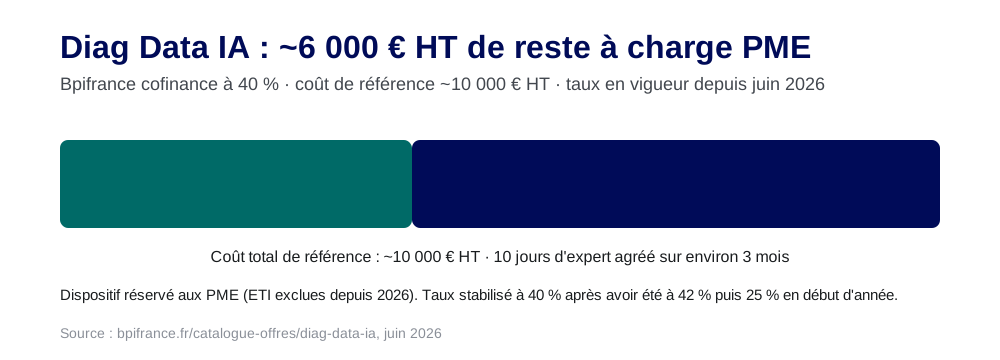
The reference cost of the assessment sits around €10,000 excl. VAT. Bpifrance has covered 40% of it since June 2026. The amount left for the company to pay is roughly €6,000 excl. VAT. That rate fluctuated earlier in the year (42% first, then 25%) before settling. This is the figure to put in any 2026 funding plan.
Is your company eligible?
The scheme is open to SMEs and mid-sized companies with 10 to 2,000 employees, generating at least €1m in revenue over a 12-month period, more than a year old, registered in France, across every sector. Most industrial, service and trading SMEs fall within scope, as do mid-sized companies up to 2,000 employees. The real point to watch is not formal eligibility, it is internal readiness. You need a minimum of usable data and genuine commitment from leadership to act on the findings, otherwise the diagnostic ends up as a report with no follow-through.
Who chooses the approved expert?
It is the company, not Bpifrance, that selects and appoints the expert on the platform. Bpifrance approves the pool of experts, but you keep control over who you work with. An expert who knows your sector or your context produces a far more useful diagnostic than a generalist audit. Our article dedicated to Bpifrance's Diag Data IA covers the selection criteria, the ten-day process, and what to expect as deliverables.
How do you fund AI training for your staff through an OPCO?
Upskilling your teams on AI is fundable through your sector's OPCO. Depending on your headcount and sector, the funding can cover a large share, or the entirety, of the training cost. It is often the fastest lever to activate, and the most cost-effective in the short term: trained teams apply the use cases immediately, with no extra technical investment.
The key condition: going through a Qualiopi-certified provider
OPCO funding requires a training provider certified under Qualiopi, France's training-quality accreditation. The good news: the provider holds the certification, not you. By choosing a Qualiopi-certified partner, you get the funding with no certification process of your own. A non-certified expert can even work as a subcontractor to a Qualiopi-certified provider, which widens the pool of specialists you can draw on depending on your sector.
The link to the AI literacy obligation under the AI Act
Since February 2025, the EU AI Act has required AI literacy for staff using these tools at work. Funding your team's training through the OPCO means meeting a regulatory obligation already in force while building skills across the company at the same time. Our Qualiopi-certified training offer sets out the framework, content and OPCO funding process for companies operating in France.
What do France Num and regional grants cover on the rollout stage?
Once the assessment is done and teams are trained, the rollout itself can be partly funded. Regional digital transformation grants vary by region and sector. The France Num portal lists them and lets you filter by region and project type.
In Nouvelle-Aquitaine, for example, regional digital transformation vouchers cover part of the deployment cost with listed providers. Other regions run their own budgets, with amounts and scope that vary by fiscal year. We cover the main regional schemes available in 2026 in a dedicated article, with direct links to the regional portals.
The France Num "Activateur" status identifies providers listed on the portal. It is a listing status, not an official quality certification. Useful for spotting providers engaged in the digital transition effort, but worth presenting for what it actually is.
Can you combine these schemes on a single project?
Yes, and that is exactly the recommended approach. These three levers cover distinct stages and follow on from each other without overlapping.
| Stage | Covers | Scheme | Funder |
|---|---|---|---|
| 1 | Assessment and scoping | Diag Data IA | Bpifrance |
| 2 | Upskilling | Training plan | OPCO |
| 3 | Rolling out the use cases | Digital transformation grant | Region / France Num |
An AI project that activates all three levers at the right time significantly cuts the overall cost compared with buying the same work with no funding at all. The golden rule: file the paperwork at the scoping stage, not after the fact. The OPCO application is filed before training starts. The Diag Data IA expert is appointed as soon as leadership signs off. The regional application opens once the workstreams are precisely defined with the expert.
For a full guide to combining these schemes and the common mistakes in the paperwork, our article on funding an AI project covers every practical detail.
Which schemes are dead or do not fund AI adoption at all?
Several grants still often mentioned are no longer usable, or simply do not apply to AI tool adoption. Confusing them wastes time and hurts the credibility of a funding application.
The €500 France Num voucher. Closed since 2021. It should not appear in a funding plan anymore, regardless of who you are talking to.
The executive training tax credit. Repealed by France's 2026 finance act. It is no longer usable, despite still appearing in many articles and comparisons published before 2026.
The innovation tax credit (CII). A 20% rate, not 30%. It funds product innovation, not the internal adoption of AI tools. Like the Research Tax Credit (CIR), citing it as a lever for AI adoption is a common mistake that can mislead a funding application.
The "France Num" label. This is an "Activateur" status, essentially a listing. It is not an official quality certification. Useful to spot engaged providers, but should be presented as what it is.
Sticking to schemes actually in force protects you against false promises and spares you late rejections when putting together an application with a bank or an administration.
How do you get started with these schemes in 2026?
The right entry point is Diag Data IA. Once priority use cases are identified and their return on investment is quantified, the training plan and rollout workstreams follow naturally, and each stage finds its funder.
The practical approach comes down to three steps. First, identify a Bpifrance-approved expert suited to your sector and start the appointment process on the platform. Second, contact your OPCO to prepare funding for the training stage before it starts. Third, explore the regional grants available once the workstreams are precisely defined with the expert.
This is the path I structure for the French companies I work with, from filing the paperwork to delivering the first operational use cases. To check whether your company is eligible and estimate the amount you would be left to pay, a first one-hour scoping call is enough to validate the assumptions, with no obligation.
Frequently asked questions
- What is the Osez l'IA plan?
- A French government initiative launched in July 2025 and reinforced in June 2026, with a €200m budget. It coordinates three tools: Diag Data IA (an assessment co-funded by Bpifrance), a free-access AI Academy, and a network of AI Ambassadors who support business leaders. It is the national reference framework for AI adoption among French companies.
- What does Bpifrance's Diag Data IA actually cost in 2026?
- For a company operating in France, the amount left to pay is roughly €6,000 excl. VAT, after Bpifrance covers 40% of a reference cost of around €10,000 excl. VAT. That rate has applied since June 2026, after fluctuating (42%, then 25%) earlier in the year. The scheme is open to SMEs and mid-sized companies (10 to 2,000 employees) registered in France.
- Can an OPCO cover the full cost of AI training in France?
- Depending on your headcount and sector, the OPCO can cover the entire cost. The condition is going through a Qualiopi-certified training provider. It is the provider, not the company, that holds this certification, which keeps the process simple on your end.
- Do the €500 France Num voucher or the training tax credit still exist in 2026?
- No. The €500 France Num voucher closed in 2021. The executive training tax credit was repealed by France's 2026 finance act. Both are dead schemes and should no longer appear in a funding plan.