How to Fund AI Training in France Through Your OPCO
By Alexandre Saint-Jean

Audio version
Audio version produced by text-to-speech from the article. Our AI charter
If you employ staff in France, AI training for your teams is fundable, largely or even entirely, through your OPCO. It is the fastest lever to activate in a transformation project: no complex paperwork, no certification to obtain on your side, and funding that simultaneously answers a regulatory obligation already in force. Here is how it works and how to file the request.
What is an OPCO, and why does it fund AI training?
OPCOs (Opérateurs de Compétences) are bodies approved by the French state that collect and redistribute companies' training contributions by professional sector. There are eleven of them, covering every sector: finance, industry, services, agriculture, culture, and more.
AI training falls squarely within what is fundable, because it builds skills that transfer directly to the job. Most OPCOs have made digital transformation and AI tools a priority topic since 2024. The level of funding depends on your sector, your headcount and the funds available: companies with fewer than fifty employees generally get the most favourable rates. Your OPCO adviser will confirm the exact amounts before you commit to anything.
Which AI training qualifies for OPCO funding in France?
Eligibility rests on two combined conditions: the training targets employees, and it is delivered by a Qualiopi-certified provider.
The fundable scope is broad. It covers: an introduction to generative AI and prompting, using AI tools for specific job functions (assisted writing, data analysis, document processing, task automation), and training on regulatory and data privacy issues. Anything that does not map to a measurable job-related skill will be harder to get funded.
One point to watch: the executive training tax credit was repealed by France's 2026 finance act. This scheme is no longer usable and should not appear in your funding plan.
Why does your training provider need to be Qualiopi-certified?
The Qualiopi certification, issued by accredited auditors, confirms that a provider meets a quality standard covering course design, learner tracking and continuous improvement. Since 2022, it has been a condition for accessing public and jointly managed training funds, including OPCO funds.
What many employers do not realise: it is the provider that is certified, not your company. You have no process to go through. It is enough to check that the provider you choose holds a current certification.
On top of that, a non-certified expert can work as a subcontractor to a Qualiopi-certified provider. This is a common arrangement that lets you bring in highly specialised AI practitioners while keeping the funding eligible. It is the model behind the AI training we offer to SME teams and leaders.
What is the link with the AI literacy obligation (AI Act, Article 4)?
Since 2 February 2025, the first provisions of the EU AI Act have applied. Its Article 4 requires anyone deploying an AI system to ensure the people using it have a sufficient level of AI literacy, appropriate to their role and to the systems involved.
In practice: if your staff use AI tools (content generation, assistants embedded in your work software), you need to give them training on what AI is, its limits and its risks. Funding that through the OPCO means killing two birds with one stone: building useful skills and documenting compliance with an obligation already in force. Our article on what the AI literacy obligation actually requires covers the evidence you need to keep on file.
How do you file an OPCO funding request?
The one rule that matters above all: the request must be filed before training starts. Training that has already begun cannot be funded retroactively, with no exceptions.
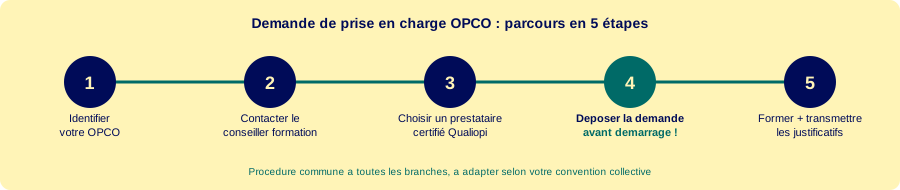
The typical process runs in five steps. First, identify your OPCO from your collective bargaining agreement (the francenum.gouv.fr portal helps find it in a few minutes). Second, contact your training adviser before choosing a provider: they will confirm the funds available and the caps that apply to your headcount. Third, select a Qualiopi-certified provider whose programme describes measurable skills. Fourth, file the funding request on your OPCO's portal before signing any agreement. Fifth, after training, submit attendance sheets, the invoice and the completion certificate to trigger reimbursement.
Most OPCOs process requests online. Reimbursement typically takes a few weeks to two months, depending on the provider.
What does OPCO-funded AI training actually cost?
For a company with fewer than fifty employees, a two-day AI training course can come down to zero or near-zero out-of-pocket cost if the funding cap is reached. For a larger company, funding typically covers 50 to 80% of the pedagogical cost, depending on the sector and the funds available.
The main variable is the hourly cap your OPCO applies under your collective bargaining agreement, typically in the range of €15 to €25 per teaching hour in many sectors. Your adviser will confirm these parameters before you commit.
The remaining out-of-pocket cost can fit into a broader funding plan. Funding an AI project in an SME covers how to combine OPCO funding, Bpifrance's Diag Data IA, and regional grants: three schemes covering distinct areas (training, assessment, rollout) that stack without overlapping.
What is the right sequence to get started?
Training does not come last. It sits between the assessment stage (which identifies the use cases to roll out) and the technical deployment (which assumes trained users). A tool deployed with no understanding behind it creates as much resistance as it does value.
For an SME starting out, the most effective sequence is: assess to prioritise, train the relevant teams (funded through the OPCO), then deploy with staff who understand what they are using. If your company is based in the Bordeaux region, AI training for English-speaking teams in Bordeaux can fit into this path with complementary regional funding. Our article on how to train your team on AI goes deeper on the pedagogical choices: in-person group sessions, e-learning, or a blended format depending on your constraints.
The first step stays simple: a call to your OPCO adviser to find out what funding is available to you. I am available to help you put together AI training that qualifies for funding, from choosing the programme to submitting the paperwork.
Frequently asked questions
- Does my company need to be Qualiopi-certified to get OPCO funding for AI training?
- No. The Qualiopi certification is held by the training provider, not your company. You have no certification process to go through. It is enough to choose a provider whose certification is current.
- What is the single most important rule for getting OPCO funding?
- The funding request must be filed before training starts. This is an absolute condition: training that has already begun cannot be funded retroactively, with no exceptions.
- Has AI training been mandatory since the AI Act?
- Article 4 of the EU AI Act requires deployers of AI systems to ensure the people using them have a sufficient level of AI literacy. This obligation has been in force since February 2025. Training your teams means meeting a regulatory requirement that already applies.
- Does OPCO funding also cover training for the business owner?
- The skills development plan funded by the OPCO targets employees. The executive training tax credit was repealed by France's 2026 finance act and is no longer usable. Check with your OPCO for the options available based on your status.
Sources
Go further
AI training funded through your OPCO