Use AI Without Losing Control of Your Company Data
By Alexandre Saint-Jean
Audio version
Audio version produced by text-to-speech from the article. Our AI charter
The first objection a business leader raises about AI is rarely technical, it is legal: "I don't want my data going to a third party." The good news is that you can benefit from AI while keeping control of your data. You just need to ask the right question, because most debates on this topic blur together three different things.
What is the real question to ask?
Before choosing a solution, separate three notions that get mixed up constantly. Until you tell them apart, you end up making bad decisions, either overpaying for sovereignty you did not need, or believing you are protected when you are not.
Data residency
This is where your data is physically stored and processed. A provider can absolutely guarantee storage and processing in Europe. That is a real, contractual and technical guarantee, but it only answers the "where" question.
Legal sovereignty
This is the question of who can lawfully demand access to your data. This is the real limit, and it is structural: it depends on the law the provider is subject to, not on where the servers happen to sit.
AI Act compliance
This is about how you govern the use of AI inside your organisation. The regulation barely touches on data location at all. Confusing it with sovereignty is the most common mistake.
Most companies that say "not in the US" actually want legal sovereignty, not just residency. Naming the real need correctly is the first step.
Why residency alone is not always enough
A US provider can store your data in Europe, that is real and solid, through arrangements such as Microsoft's EU Data Boundary. But as a company incorporated under US law, it remains subject to the CLOUD Act, regardless of where the servers are located. No technical or contractual arrangement fully neutralises that exposure.
Residency is not sovereignty. Residency tells you where the data sits, sovereignty tells you who has legal control over it.
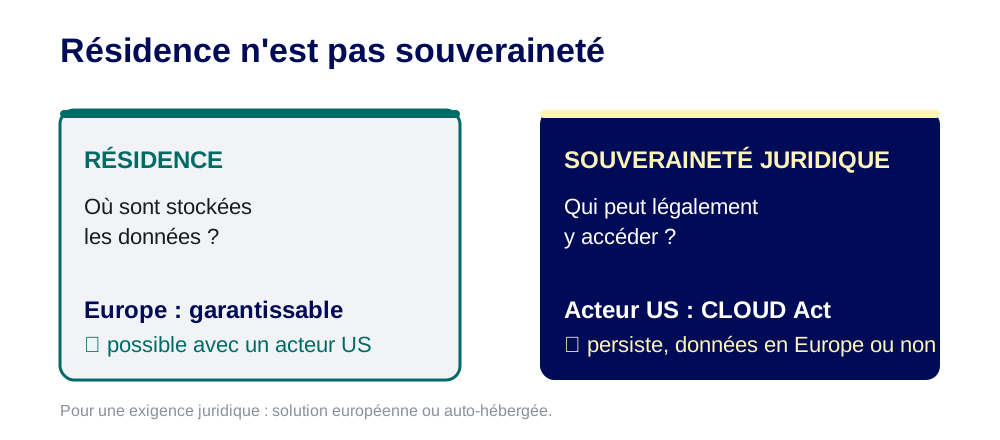
This does not mean a US cloud provider is off the table. For a lot of data, European residency plus a contractual commitment not to reuse it for training is more than enough. The key is to decide consciously, data set by data set.
What are your options when the requirement is strict?
When the sensitivity of the context demands strong legal control, three families of solutions exist. You choose between them based on the level of requirement, not on principle alone.
A managed European solution
Mistral offers frontier-grade models, available through an offer hosted in Europe (Le Chat Enterprise, for example) or deployed on your own infrastructure. You keep a provider incorporated under European law, which answers the legal sovereignty question directly. For the detail of the offers and deployment options, see our overview of sovereign European models. The field also widens quickly beyond Europe: see why the battle of open models matters for a small business too.
A self-hosted open-source model
When control needs to be total, you deploy an open model (Mistral, Qwen) on infrastructure you control: a European cloud such as OVHcloud or Scaleway, or your own servers, using tools such as Ollama or vLLM. The data never leaves your perimeter.
A compliant cloud, when residency is enough
If your real need is residency and you are already set up with a provider, a compliant cloud (EU residency, data not used to train the models) remains a pragmatic, quick-to-implement option. What is left to settle is what GDPR actually allows you to do with that data, which is the subject of your obligations under GDPR and generative AI. A recent case illustrates the stakes well: see what a healthtech AI opt-out teaches SMEs about GDPR.
How do you choose the right level?
The right level of sovereignty is decided data type by data type, not as a blanket policy. A simple grid:
| Data sensitivity | Requirement | Suitable solution |
|---|---|---|
| Low (public content, drafts) | None | Compliant cloud, EU residency |
| Medium (routine internal data) | Residency | Compliant cloud or hosted Mistral |
| High (strategic data, trade secrets) | Legal sovereignty | Sovereign Mistral or self-hosted open source |
This mapping avoids both naivety and over-engineering. You put the right level of protection where it belongs, and only there.
What questions should you ask your AI provider?
Before signing anything, a few simple questions reveal the real level of control, far better than a sales pitch:
- Where exactly is my data stored and processed? Ask for the specific region, not a vague "in Europe".
- What law is your company subject to? This is the sovereignty question, distinct from the previous one.
- Is my data used to train your models? The answer should be a contractual no.
- Can I self-host or isolate the model? This tells you whether a fully controlled option exists.
- What is the retention period, and can I take my data with me if I leave? You need to be able to walk away with your data.
If a provider dodges any of these questions, that is a signal. A serious partner answers clearly, and in writing.
Where does the AI Act fit into all this?
The AI Act does not require you to host in Europe. It asks you to classify your uses by risk level, keep a human in the loop, be transparent about your use of AI, and train your staff. Choosing a sovereign model is therefore a GDPR and sovereignty argument, not an AI Act obligation. For the practical compliance checklist, see what the EU AI Act requires from SMEs.
Sovereignty is also something to design in at the moment you connect AI to your business tools, which is the subject of putting AI into an ERP.
The right instinct: break down the real need before choosing an architecture. That is exactly the starting point of my sovereign, compliant AI advisory work.
Frequently asked questions
- Does my data stay in Europe if I use a US cloud provider?
- Residency, where the data is stored, can be guaranteed in Europe. Legal sovereignty, who can lawfully demand access, cannot be fully guaranteed by a US provider, because of the CLOUD Act.
- Does the AI Act require me to host my data in Europe?
- No. The AI Act does not deal with data location. It requires you to classify your uses by risk level, be transparent, and train your staff. Location is a matter of GDPR and sovereignty, not the AI Act.
- What sovereign alternatives exist?
- European models such as Mistral, available hosted in Europe or self-hosted, or open-source models run on infrastructure you control, a European cloud such as OVHcloud or Scaleway, or on-premise.
- Is an open-source model less capable?
- Less so in 2026. Open models such as Mistral or Qwen now reach a level that is more than sufficient for the vast majority of business uses: summarising, extracting, working as a copilot over your own data. For a small business, the performance gap is almost never the deciding factor. Control and cost are.
Sources
Go further
Sovereign, AI Act-compliant AI